A WORKING-ANCESTRY COMPANION
Make room for
a shared routine.
For this ancestry, planning for an active, engaged companion is sensible. The Australian Shepherd brings an energetic herding heritage; the Siberian Husky brings a history of endurance and an inclination to run. These are parent-breed tendencies to consider when learning about an individual Ausky. refref
A practical plan combines daily movement, opportunities to explore with you, short learning sessions, and time to settle. Adjust activity to age, fitness, and your veterinarian’s advice. Ask what the dog’s current routine looks like and how it responds when the day is quieter.
Train for the life you actually share.
Reward-based training is the approach recommended by the American Veterinary Society of Animal Behavior. Build everyday skills such as loose-leash walking, recall practice in safe settings, comfortable handling, and settling around normal household activity. ref
A STRONG START
Ask how a dog learns, what it finds rewarding, and what support you can get as it matures. Intelligence and easy training are different things.
YOUR HOUSEHOLD MATTERS
Match the dog
to your real world.
Time & companionship
The Siberian parent club emphasizes the breed’s social nature. Think through workdays, alone-time practice, and who will provide care when your schedule changes. ref
Children & other animals
Meet the individual dog and discuss its history around children and other pets. Supervise interactions. Siberian ancestry makes questions about chasing and small-animal safety particularly relevant; friendly behavior with people does not establish safety with cats or small pets. ref
Space & secure exercise
A yard is one part of a plan. Consider secure boundaries, leash routines, and how you will provide exercise and engagement. The Siberian parent club specifically advises controlled or enclosed exercise because of the breed’s urge to run. ref
Inherited tendencies are context, not a complete personality profile. Training, environment, and experience also matter. ref
LIVING WITH THE COAT
Expect some fur
in the story.
The parent breeds have coats that need attention, and shedding is a practical expectation to discuss. Siberians are known for substantial seasonal coat shedding. Ask about the individual dog’s coat, brushing needs, and comfort with grooming. ref
Make handling and grooming part of a calm routine. Choose tools and a care schedule suited to the actual coat, with advice from a qualified groomer or veterinarian when needed.
BEAUTY & WELL-BEING
Ask for the
actual evidence.
Health questions should follow the individual dog’s ancestry and family history. Request dated results for the actual parents, ask what each test does and does not cover, and involve your veterinarian in interpreting what is relevant for your dog. OFA explains how parent-club screening recommendations and public records can support that conversation. ref
| Ancestry | A starting point for discussion |
|---|---|
| Australian Shepherd | USASA highlights hip and elbow evaluations, eye examinations, and additional genetic concerns such as MDR1 drug sensitivity. Ask which results apply to the parents. ref |
| Siberian Husky | The parent club’s health statement includes eye and hip screening, plus genetic testing for SPS1 and SHPN1 in breeding dogs. ref |
These are parent-breed resources to discuss with a veterinarian. A screening panel is not a guarantee against every health problem.
A thoughtful note about merle.
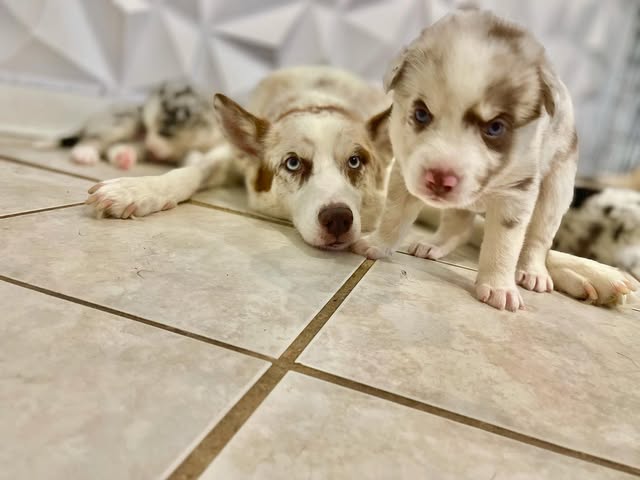
Merle is a coat-pigment pattern with complex inheritance. UC Davis notes that breeding dogs carrying merle variants can produce double-merle offspring with health risks, including hearing and eye defects. Some merle variants can be hard to recognize by appearance. Genetic testing and careful interpretation matter when assessing a pairing. ref
Enjoy the pattern. Ask the health questions with the same care.
BEFORE YOU DECIDE
Five conversations
worth having.
What does an ordinary weekday look like?
Consider activity, training, companionship, rest, and a backup plan for busy days.
What is this dog actually like?
Ask about confidence, sensitivity, handling, settling, chasing, and experience with your kind of household.
What can I learn about the family?
Request ancestry information, parents’ mature sizes, health records, and observations of related adult dogs.
What support comes with the relationship?
Discuss socialization, veterinary records, transition guidance, and who to contact as the dog grows.
Am I drawn to the whole dog?
Make room for the daily commitment as well as the striking photograph.
For individual medical concerns, use your veterinarian; for significant behavior concerns, seek qualified help with your veterinarian’s involvement.
Sources & further reading Sources checked October 31, 2026
- USASA · The Australian Shepherd
- Siberian Husky Club of America · The Siberian Husky
- Siberian Husky Club of America · Before choosing a Husky
- Embark · Ancestry and individual behavior
- AVSAB · Humane dog training position
- USASA · Health and genetics
- Siberian Husky Club of America · Health statement
- UC Davis Veterinary Genetics Laboratory · Merle
- Orthopedic Foundation for Animals · Health screening
Parent-breed information provides context. Individual dogs can differ; ask about the specific dog and its documented ancestry.