THE SHORT ANSWER
Meet the
Australian Husky.
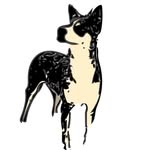
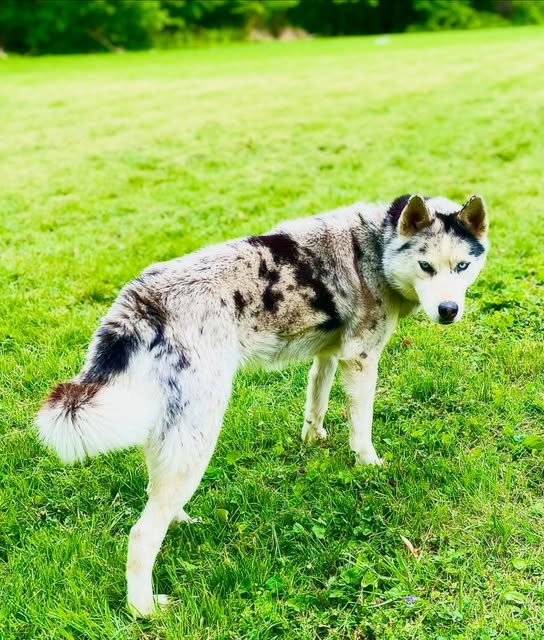
At Dreamline, “Ausky” means an Australian Shepherd–Siberian Husky cross and the developing, multigenerational lineage built from that foundation. We also use the name Australian Husky.
The ancestry is the starting point. It does not make every dog a fixed blend of the two parents’ appearance or personality. Ask about a dog’s actual family tree, meet the individual, and learn how it has been raised.
This is Dreamline’s use of the name. Confirm the ancestry behind any dog described as an Ausky.
THE PARENT BREEDS
The clearest history
starts with the roots.
The Australian Shepherd
Despite its name, the Australian Shepherd developed in the United States. Its story is tied to ranch work, livestock, and the people who valued a versatile herding dog. Intelligence, activity, and a strong desire for purposeful engagement remain important parts of that heritage. ref
The Dreamline chapter
Our own story spans more than a decade and three generations. We see an opportunity to contribute a thoughtful, recognizable lineage to the Ausky’s developing identity.
Explore the Dreamline lineageTHE BEAUTY OF VARIATION
There is more than
one Ausky expression.
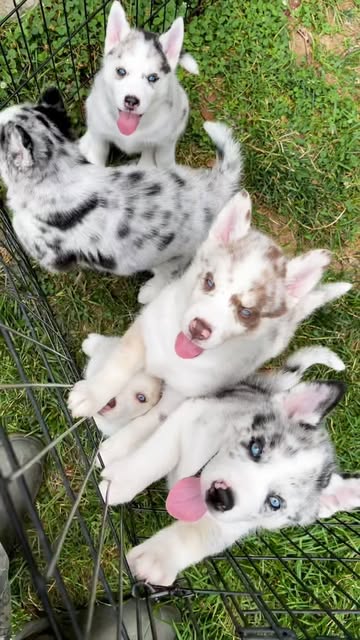
Coat patterns, size, and other visible features can vary between dogs—even among siblings. Genes are inherited in different combinations; a mixed-breed dog does not have to display the most recognizable features of every breed in its ancestry. ref
Temperament is individual, too. Ancestry offers context, while genetics, environment, and experience interact in complex ways. A photograph, coat color, or breed label cannot tell you exactly how a dog will behave. ref
A USEFUL WAY TO THINK ABOUT IT
Use the parent breeds to ask better questions. Use the individual dog and its history to make a better decision.
THE AUSTRALIAN SHEPHERD PALETTE
Four color families.
Many expressions.
The Australian Shepherd standard names black, blue merle, red, and red merle. Each may appear with or without white markings and/or tan, often called copper. Those marking combinations explain labels such as “black tri” or “red and white.” ref
Showing white + copper markings, often described as tri-color.
Black
The black coat family, with the markings shown below.
With white + copperBlue merle
Darker patches against a lighter gray background.
With white + copperRed
The red/brown coat family, with the same marking options.
With white + copperRed merle
Red/brown patches against a lighter background.
With white + copperOriginal, stylized color examples. Marking placement and shades vary. Eyes are schematic; eye color is not fixed by these coat labels. These illustrations are not photographs of Dreamline dogs.
Pattern is one part of the picture.
Merle describes a pigment pattern. White markings, copper points, coat texture, and eye color add other layers to the appearance. Several genetic factors shape the coat; they are not one interchangeable “color gene.” ref
The Australian Shepherd palette is part of Dreamline’s inspiration. The Siberian Husky also has its own range of colors. A particular dog’s inherited result depends on its actual ancestry and genetic makeup.
See the Dreamline direction Explore coat genetics and health questionsCOMMON QUESTIONS
A little more
understanding.
How big does an Ausky get?
The parent breeds are medium-sized, but a particular cross can vary in build and adult size. Ask for the actual parents’ mature weights and heights, and information about grown dogs from related litters. A single universal weight range would hide that variation. refref
Are all Auskys merle or blue-eyed?
No single look defines every dog in this lineage. The photographs on this site show individual Dreamline dogs, and inherited features can vary. Ask about the specific pairing and the individual dog. ref
Is an Ausky a purebred dog?
The Ausky described here is a developing crossbreed lineage with Australian Shepherd and Siberian Husky ancestry. Dreamline’s vision for its own lineage is an evolving breeding philosophy.
What does “three generations” mean at Dreamline?
It describes the continuity of our own breeding story, from our beginnings to our youngest third-generation female. The family tree is the place to understand a particular dog’s ancestry.
Could an Ausky be a good fit for my family?
Start with your daily routine, activity, training time, other animals, and expectations. Then ask about the actual dog’s temperament and experience. Our Life & Care guide helps you think through those decisions.
Explore life with an AuskySources & further reading Sources checked October 31, 2026
- USASA · The Australian Shepherd
- Siberian Husky Club of America · Breed history
- Siberian Husky Club of America · The Siberian Husky
- Embark · Why mixed-breed siblings may look different
- Embark · Ancestry and individual behavior
- AKC · Australian Shepherd standard
- UC Davis Veterinary Genetics Laboratory · Coat color and type
Parent-breed information provides context. Individual dogs can differ; ask about the specific dog and its documented ancestry.